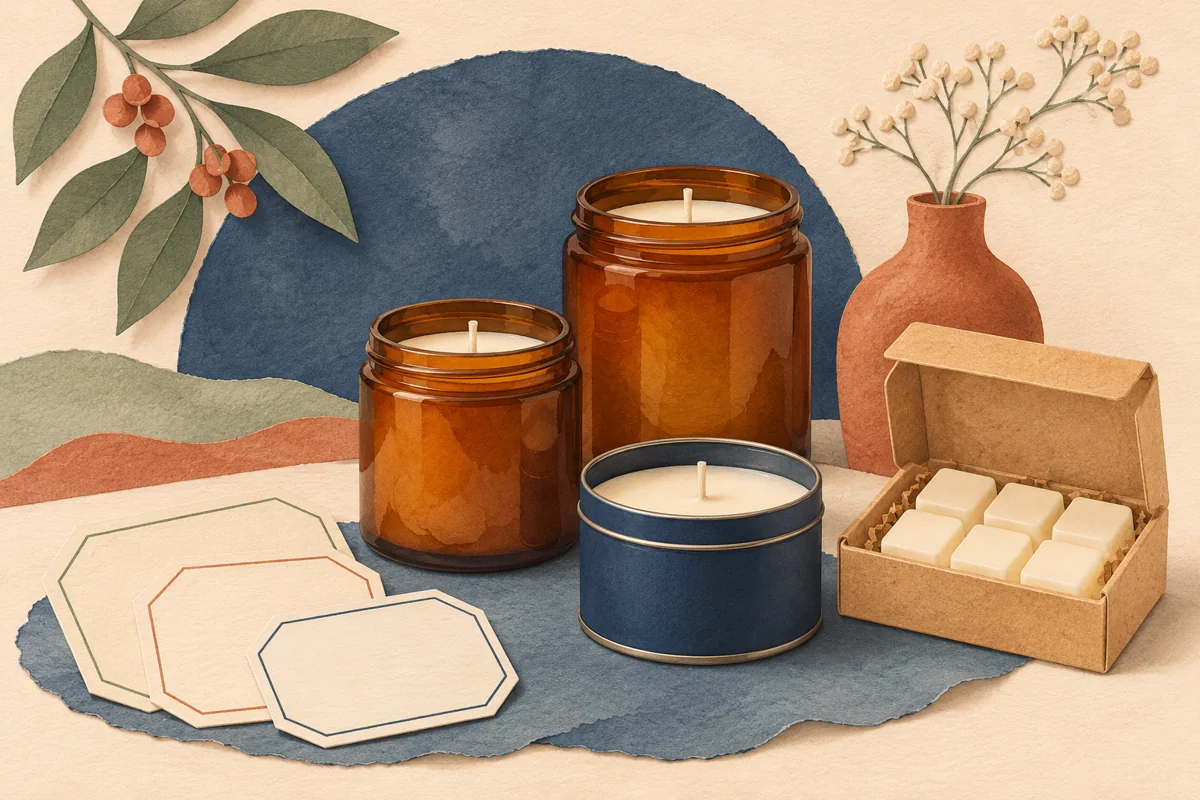
A drawer-style candle box reveals its contents in stages. The outside sleeve is visible first, followed by the drawer edge and then the card or product inside. A generic thank-you insert may sit across that sequence awkwardly. Plan what the customer sees at each stage before deciding whether a reveal card belongs above, beside or underneath the candle.
01
Document the opening sequence in ordinary steps
LESER offers candle packaging for different vessel formats. Start with the exact drawer structure your supplier proposes, not an illustration of a similar gift box. Open an empty sample using its intended pull and mark the surfaces that become visible before the product itself.
For a hypothetical single-candle gift, record three views: closed, drawer partly open and fully open. Decide whether the first message should identify the scent, welcome the recipient or explain the contents. Choosing one main role keeps the card from becoming a crowded miniature brochure placed over an already labeled product.
02
Fit the card to the moving construction
Measure the usable card location after the approved insert and candle are fitted. Check the drawer rails, pull tab and any finger recess. The card should not need to bend around a feature simply because a common postcard size seemed convenient in the design application.
Try two paper positions on the same sample: resting above the insert and held beside the candle in a supplier-approved space. Open the drawer normally and observe whether the card shifts, catches or hides the pull. Describe any interference to the packaging supplier before changing the insert or fastening method yourself.
| Proof item | Record |
|---|---|
| Record the opening sequence. | Exact supplier or artwork reference |
| Check the card’s moving clearance. | Observation on the assembled sample |
| Choose one first-message role. | Approved change or acceptance |
03
Write for the first visible moment
Use a short heading that makes sense without the outer sleeve next to it. A recipient may open the box after someone else has removed its shipping packaging. If the card refers to a collection nickname, support that nickname with the actual product identity or another clear reference.
Compare the first visible line with the jar label underneath. Repeating the same long scent title on every layer can waste the card’s useful space. Instead, give the card a distinct purpose such as a concise gift greeting while leaving approved care wording in its intended location. Do not invent recipient personalization or maker claims.
04
Approve the reveal and removal together
Lift the card out, set it aside and inspect what remains visible in the drawer. Keep the packed reference truthful to what buyers receive: decorative tissue, ribbons and extra cards should not appear in the reference unless they are included in the actual assembly.
Save photographs of the three accepted views and the card’s exact position. Editable Canva layouts can coordinate that visual sequence, but the box, insert and printed card remain separate production items. Revisit the reveal when changing vessel height or pull direction because those changes alter what the customer encounters first.
BEFORE YOUR NEXT STEP
Your practical checklist
- Record the opening sequence.
- Check the card’s moving clearance.
- Choose one first-message role.
- Save the partly opened reference.
Questions & answers
Can a standard postcard go in every drawer box?+
Check the actual drawer and insert. A convenient card size may obstruct a pull, catch an edge or cover more of the product than intended.
Should the card repeat the jar label?+
It may identify the product where useful, but it should have a deliberate communication role rather than duplicating every line beneath it.
Sources & further reading
Official references for the technical points in this guide. Check current specifications before production.