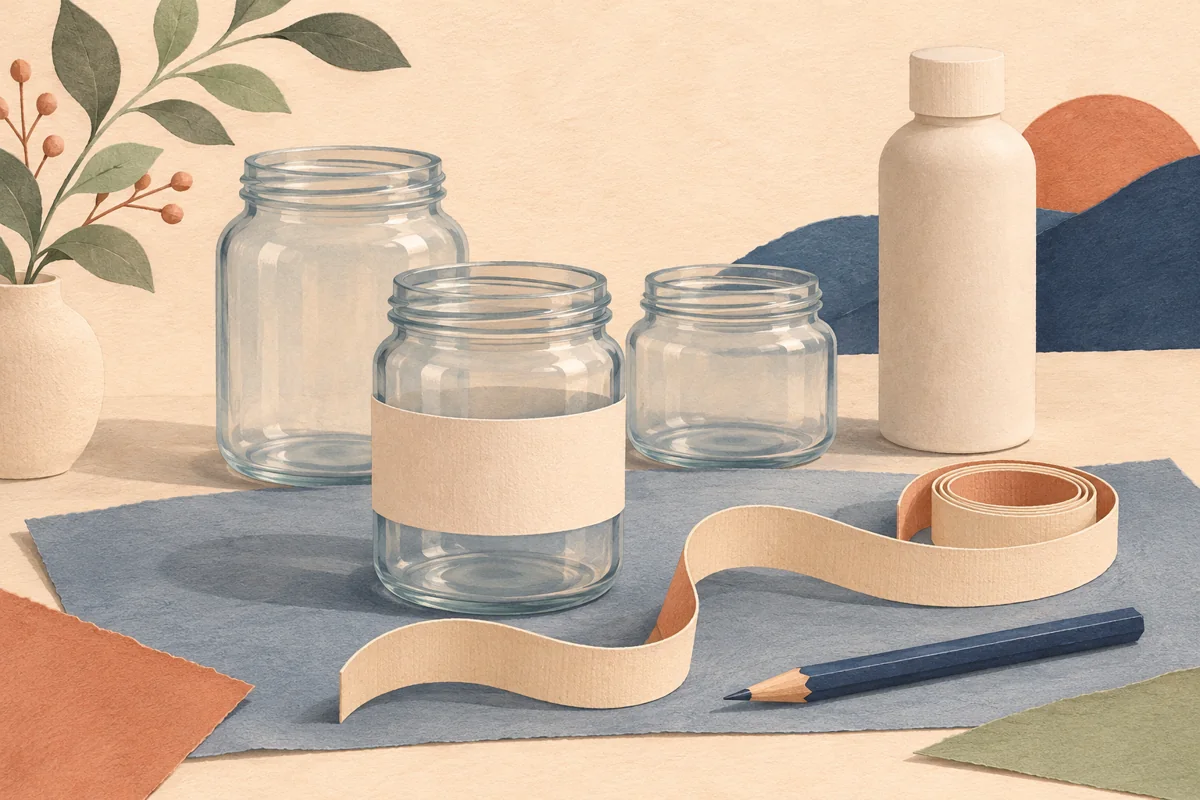
Two cosmetic jars with the same listed capacity can have very different silhouettes. One might be broad and shallow, while another is narrow with a thick base. Compare the full specifications before choosing label dimensions, gift-box space or the quantity your finished product can actually use.
01
Separate capacity from the outside measurements
Use the capacity field to understand the container specification, then record the exterior dimensions separately. Thick walls, a heavy base and a large lid can change how much room a jar occupies without changing its listed capacity. These differences matter for label height and packing arrangements.
Berlin Packaging distinguishes nominal jar capacity from product content expressed by weight in its filling guidance. Read the definition supplied for the particular container. Do not copy a supplier’s capacity number directly into a net-content statement or assume one milliliter of every formula weighs one gram.
02
Build a comparison sheet for real samples
Request a small number of candidate jars with their intended closures. Label the empty samples A, B and C and record the supplier references. Photograph them together from the side and above so the shape differences remain visible when you review the numbers later.
For an illustrative comparison, a broad jar and a tall jar might both be listed as 60 ml. Record their actual heights, widths and usable label panels in the blank fields below. The example is a worksheet structure, not a claim about the dimensions of any particular supplier’s product.
| Measurement | Broad jar A | Tall jar B |
|---|---|---|
| Supplier-listed capacity | 60 ml example | 60 ml example |
| Closed outside height | Measure sample | Measure sample |
| Widest outside diameter | Measure sample | Measure sample |
| Straight label height | Measure sample | Measure sample |
| Closure reference | Record specification | Record specification |
03
Check the complete closed container
Confirm the matching closure with the supplier, including any components specified for your packaging. Assemble the jar before measuring the overall height. A cap can overhang the body or cover part of the area you expected to label.
Wrap a paper strip around the usable body and add a paper circle to the lid if needed. Check shoulders, curves and opening clearance. Keep these fit observations separate from formula suitability, which requires its own appropriate packaging evaluation.
04
Evaluate the jar in the selling format
Place each candidate in the intended box, shelf row or skincare set. Compare the room needed for fingers, dividers and other products. The smallest outside jar is not always the easiest one to label or arrange, so review the complete task rather than choosing on capacity alone.
Save the chosen jar specification with the label file and packing reference. Recheck physical dimensions if the supplier or container changes, even when the advertised capacity stays the same. A digital label template can then be adapted to the measured usable panel and proofed at actual size.
BEFORE YOUR NEXT STEP
Your practical checklist
- Read the supplier capacity definition.
- Record closed outside dimensions.
- Check the matching closure.
- Measure usable label space on the sample.
Questions & answers
Does a 60 ml jar hold 60 g of my cosmetic?+
That cannot be determined from the capacity alone. Product density and the intended filling process must be considered for the actual formula.
Can I reuse a label when switching to the same capacity jar?+
Check the new shape first. The usable body height, circumference and closure position may differ.
Sources & further reading
Official references for the technical points in this guide. Check current specifications before production.