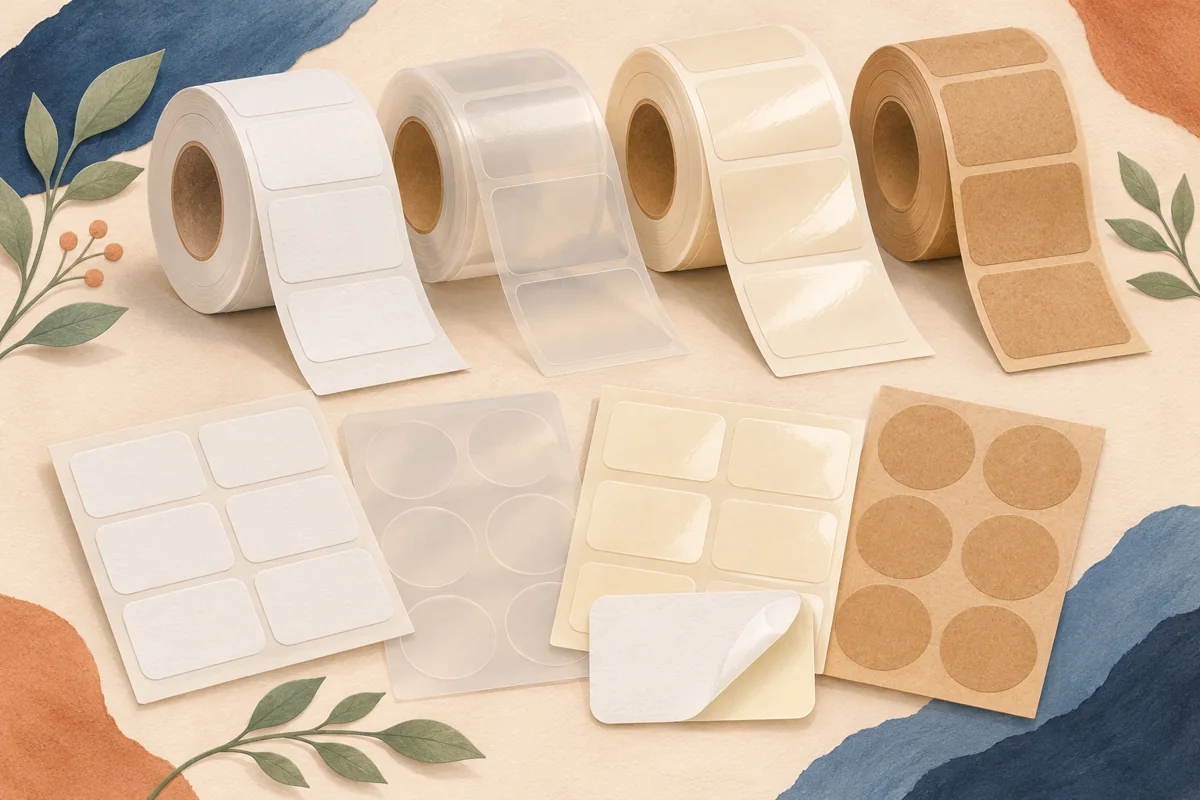
A curled label sheet on the bench is a different starting point from a label corner lifting off a jar. Before adjusting application technique, identify whether the sheet arrived curled, changed during storage or curled only after printing. That timeline points the investigation toward the stock, environment or print workflow.
01
Establish when the shape changes
Compare an unopened or protected sample from the same stock with material already on the bench. Note whether the whole sheet curves, individual labels lift from the liner or only the freshly printed output changes. Keep the comparison at the same stage of handling so the observations are meaningful.
For an illustrative soap-label job, mark three records: stock as opened, stock before printing and printed output. A photograph beside the label code and storage date creates a useful timeline. It also prevents a later discussion from treating every bent sample as evidence of the same cause.
02
Use the product-specific storage guidance
Avery’s guidance for its 5667 product identifies temperature and humidity swings as a factor in sheet stability. That is useful evidence that the environment can matter, but it is not a universal storage specification for every paper, film or adhesive. Ask the supplier for the conditions and acclimation instructions for your exact stock.
Store unused material in its protective packaging as directed and keep the lot or product identification available. If a new pack looks different from an earlier accepted pack, document that comparison before changing the design or ordering a different adhesive. The visible curl alone does not identify a complete solution.
03
Separate printing effects from storage effects
If unprinted sheets remain flat but output curls, verify printer compatibility and the recommended media setting. Review the exact machine guidance and stock instructions together. A printer setting changes the processing conditions; it should be chosen for the material rather than by trial-and-error escalation.
Do not apply heat, moisture or heavy improvised flattening to the labels without supplier approval. Such treatment can alter more than the visible shape. If lifted corners or exposed adhesive make a sheet unsuitable for feeding, set it aside and ask the supplier how to proceed.
| Stage first affected | Information to collect |
|---|---|
| Before opening | Pack condition and product lot |
| After bench storage | Exposure history and time out of packaging |
| Only after printing | Printer, media setting and output sample |
| Only on the container | Separate fit and adhesion investigation |
04
Document the accepted correction
Ask the supplier whether the observed stock can be used, needs a prescribed conditioning period or should be replaced. Record its answer with the samples. A short successful proof is more useful than assuming that a sheet which looks flatter will now print and apply correctly.
Once the sheet problem is addressed, check the finished label on the real package through the normal packing routine. Keep that final step separate in the record. The editable artwork determines the layout; the label stock and its handling determine whether the physical sheet reaches the application stage in usable condition.
BEFORE YOUR NEXT STEP
Your practical checklist
- Record the first stage where curling appears.
- Separate unopened, bench and printed samples.
- Use exact-stock storage instructions.
- Avoid feeding distorted or lifting sheets.
Questions & answers
Does curling before application prove the jar needs a stronger adhesive?+
No. The problem may occur before the label touches the jar. Establish the timeline and ask the supplier to assess the stock first.
Can I flatten curled sheets with heat?+
Do not improvise heat treatment. Follow the label supplier’s instructions, since changing temperature can affect the stock and adhesive as well as its shape.
Sources & further reading
Official references for the technical points in this guide. Check current specifications before production.