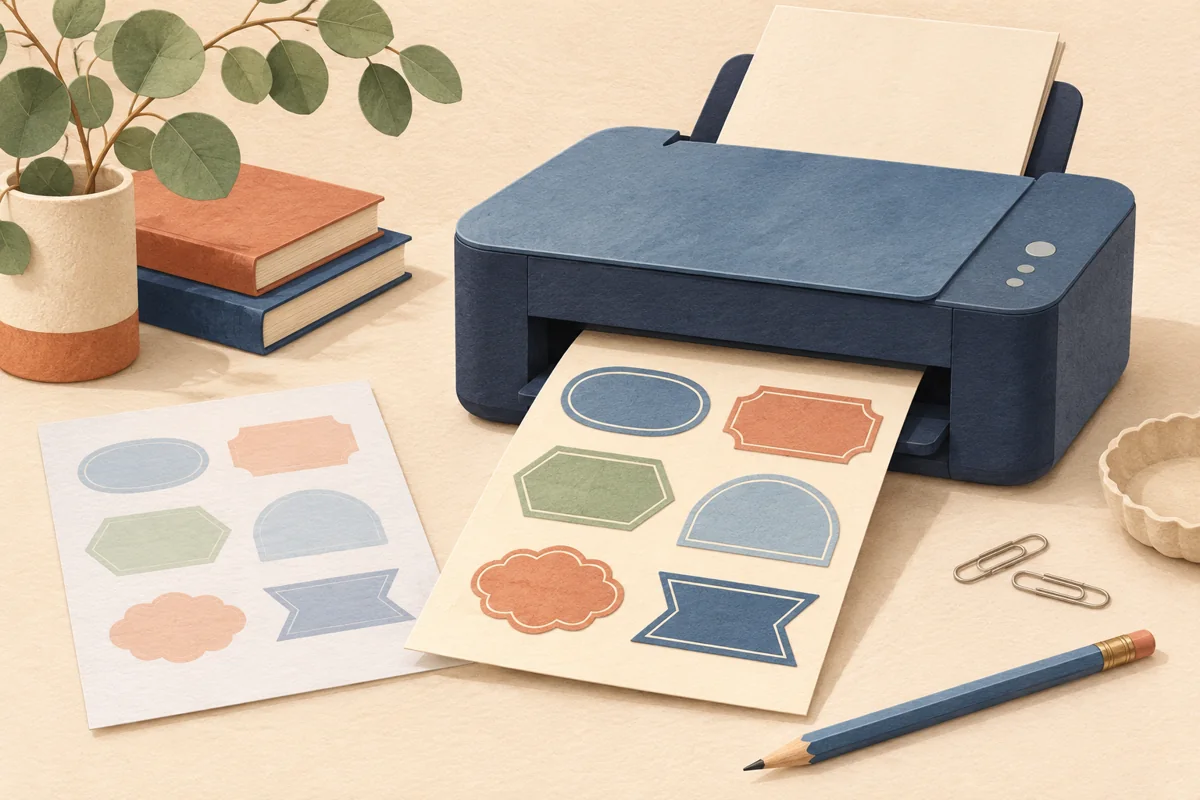
An order for 200 products does not always mean an order for 200 labels. A jar may need front and back pieces, a gift set may carry an extra outer label, and one slow-selling variant can leave you with an awkward stack of unused stock. Start by counting the packaging pieces for each sellable unit.
01
Count each design separately
Write down the number of products you plan to pack and the labels attached to each one. Split front, back, lid and gift-box labels into separate lines when they use different artwork. A shared back label may serve several variants, while the front label carries a distinct name.
For an illustrative batch of 60 jars, suppose 30 are apricot and 30 raspberry. Each jar uses one variant front and one shared back. The starting requirement is 30 apricot fronts, 30 raspberry fronts and 60 backs. An order described simply as 120 labels could easily hide that split.
02
Give spare stock a reason
Allow for the proofs you will actually print or request, the application losses you have measured and any planned photography samples. Record each allowance separately. A blanket percentage is harder to question when you cannot see which production step it is intended to cover.
If your first batch has no reliable loss history, use a modest explicit assumption and review the outcome after packing. Count unused and damaged pieces by design. You can then refine the next order using your process rather than copying another maker’s allowance.
| Quantity line | Illustrative calculation |
|---|---|
| Apricot front | 30 units plus stated spare allowance |
| Raspberry front | 30 units plus stated spare allowance |
| Shared back | 60 units plus stated spare allowance |
03
Separate stable and changeable information
Brand artwork and a general product identity may stay stable for months. Event dates, seasonal messages and evolving instructions can change sooner. Ask the printer whether those differences can be handled as separate artwork variants or a small secondary print run.
Keep current artwork connected to the stock count. A full box of old labels can look like available inventory until someone notices the previous address or product name. Mark the approved version clearly and store superseded material separately from labels ready to pack.
04
Plan the reorder before the drawer is empty
Check the supplier’s current production and delivery estimate, then compare it with the rate at which you use each design. Your quickest-selling scent may need another order while the shared back label still has plenty of stock.
Before placing the next order, review the actual unit count, the approved physical proof and the file version together. This is a useful point to check whether a new package size needs a different label, rather than automatically repeating the previous quantity and dimensions.
BEFORE YOUR NEXT STEP
Your practical checklist
- Count each artwork variant.
- Separate front, back and outer-pack needs.
- Explain every spare allowance.
- Check stock versions before reordering.
Questions & answers
Should I order all variants in equal quantities?+
Use expected unit quantities for each variant. Equal label runs only make sense when the product plan supports them.
Can I print changing details separately?+
Ask your printer about the available workflow and compatible materials, then test the completed package before committing.
Sources & further reading
Official references for the technical points in this guide. Check current specifications before production.