Popcorn can fill a large bag without giving its front a firm, flat surface. A broad label may bend over the pieces, while a small label can disappear below a basket rim. Treat volume, closure shape and display height as design inputs rather than choosing artwork from bag width alone.
01
Inspect the standing bag’s shape
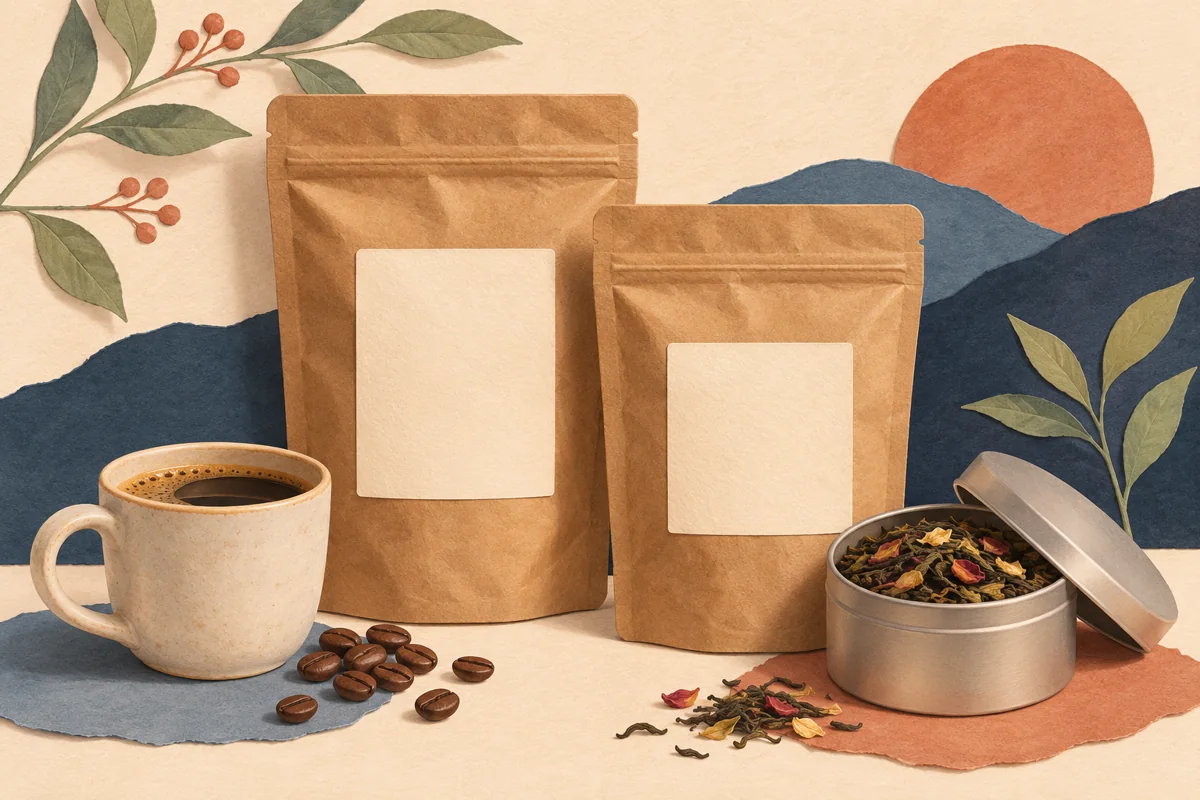
ClearBags offers gusseted bags with paper inserts for lightweight, bulky treats including popcorn. Its product pages distinguish bag dimensions and closure suitability. Use the exact specification for the chosen item, then test your actual product rather than interpreting the flat dimensions as a finished front-panel drawing.
Stand the sample on the surface where it will be sold. Mark the broad front, the expanding sides and the point where the top gathers or folds. A label that reaches into a moving gusset can crease even when it lies neatly on an empty bag. Sketch a quieter panel within those boundaries.
02
Compare two label positions in a real basket
Imagine a range with Sea Salt and Caramel Crunch. Create one paper label near the upper front and another at the center. Place the bags inside the planned basket. The center may be concealed by the basket wall, while the upper label may bend as the closure gathers.
Adjust the position before reducing the type size. Make the flavor name the part that survives a quick glance. Leave enough clear bag visible to show the actual product if that is part of the presentation. Do not let decorative swirls become the only cue distinguishing two recipes.
| Paper trial | Key question |
|---|---|
| Upper label | Does the gathered top bend it? |
| Central label | Does the display hide the flavor? |
| Sharing and favor sizes | Is each written identity clear? |
03
Plan large and small pack identities
A small favor bag and a sharing bag can use coordinated artwork without using an identical label. Keep the name order stable, then adapt spacing to the usable panel on each pack. The larger bag may accommodate a rear information layout that a tiny favor format cannot reproduce at the same scale.
Use owner-approved wording for quantity, ingredients and any product instructions. Keep recipe-specific details connected to the right size and variant. If a mixed gift order contains both flavors, check that an assembler can distinguish the packs from their written labels before placing them into the outer box.
04
Test the completed assembly sequence
Prepare a small mock batch with the chosen closure, labels and any gift ribbon. Watch for places where a hand naturally grips the front. Apply the real label stock to samples as directed by its supplier and inspect the result in the standing display, not only while holding the pack flat.
Save a photo that shows the approved distance from the closure or another repeatable feature. Recheck the layout when the portion, recipe or bag changes. Digital artwork supports the branding decision; it does not replace appropriate packaging selection or establish the product’s shelf life.
BEFORE YOUR NEXT STEP
Your practical checklist
- Fill the intended portion first.
- Mark gussets and the closure zone.
- Check labels inside the real display.
- Match wording to the correct size.
Questions & answers
Can I use a label to make an unsuitable bag stand?+
Choose a pack construction that suits the product and display. A decorative sticker should not be treated as a structural fix for an unsuitable bag.
Will the same design fit favor and sharing bags?+
The visual system can coordinate them, but each physical format needs its own readable layout and fit check.
Sources & further reading
Official references for the technical points in this guide. Check current specifications before production.