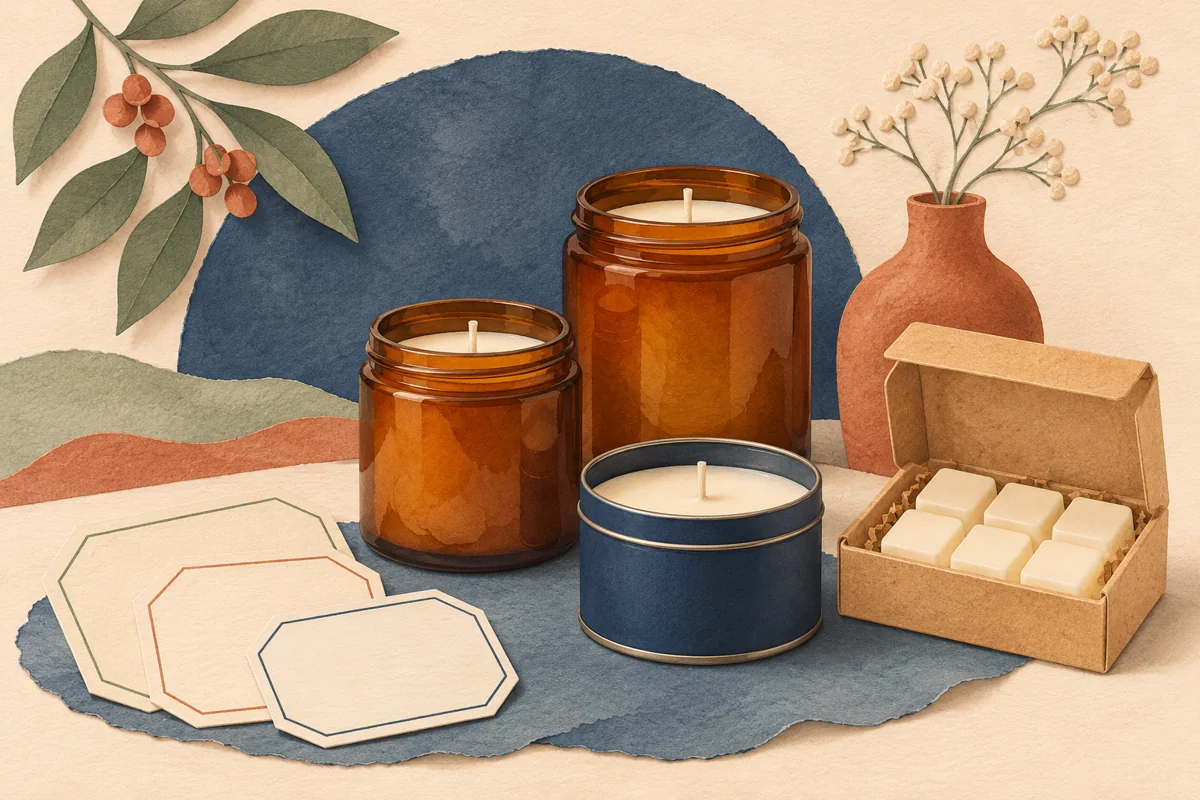
Tins and glass jars give a candle collection different visual surfaces. A short tin may be seen mainly from above, while a tall jar can present a broad front label. Compare the complete retail packages so the choice supports the way you display, label and pack your candles.
01
Compare the view a shopper will actually see
Place the candidates in the display you plan to use. A tin lying in a shallow tray can present its lid clearly, while a jar behind another row may show only the upper front panel. Mark the words that must remain visible, especially the scent and size.
Try one shared label style on both vessels. Use the same type family and scent position, then change the layout to suit each panel. A circular lid label and a short side band can belong to the same range without being scaled copies of a tall jar front.
02
Work around the closure
Measure with the lid attached and test how someone opens the package. Keep a label away from a seam if opening should leave it intact. If you deliberately use a closure seal, review its position as a separate packaging component.
For an illustrative comparison, tape the jar proof below its shoulder and the tin proof inside its flat lid area. Open and close both repeatedly with the paper samples in place. Observe any edge that catches a hand or folds against a rim.
| Packaging detail | Tin sample | Glass sample |
|---|---|---|
| Main view | Check lid and shallow sidewall. | Check the front panel and shoulder. |
| Closure | Measure the seam and lid inset. | Measure lid overhang and grip. |
| Outer pack | Fit the assembled tin. | Fit the jar, lid and protection. |
03
Design the outer pack for the exact model
Ask the packaging supplier about a box and insert suited to the assembled vessel. A stock carton described for a candle capacity is only a candidate until you have checked the actual inside dimensions and closure clearance.
Place a paper label on the packed sample and carry it in your intended retail bag. Check that the scent is still easy to identify and that a shopper can lift the candle out comfortably. Keep any protective design approval separate from the artwork approval.
04
Keep product claims tied to the finished candle
Packaging appearance does not establish how a candle performs. Use the vessel and care directions approved for the finished product. If the tin and jar versions differ, match the appropriate directions and product identifier to each one.
Save an assembled reference for both formats. A packer should be able to distinguish the right lid, label and carton without comparing tiny text. Review new scent names in both layouts before ordering printed stock.
BEFORE YOUR NEXT STEP
Your practical checklist
- Compare the intended shelf view.
- Measure with closures attached.
- Use a sample outer pack.
- Match directions to the actual candle.
Questions & answers
Can the same artwork work on a tin and a jar?+
Share the style, but adjust the panel shape and text layout to fit each vessel.
Does a package comparison decide candle performance?+
Use your finished product specifications and supplier guidance for that decision. This comparison helps plan labels and presentation.
Sources & further reading
Official references for the technical points in this guide. Check current specifications before production.