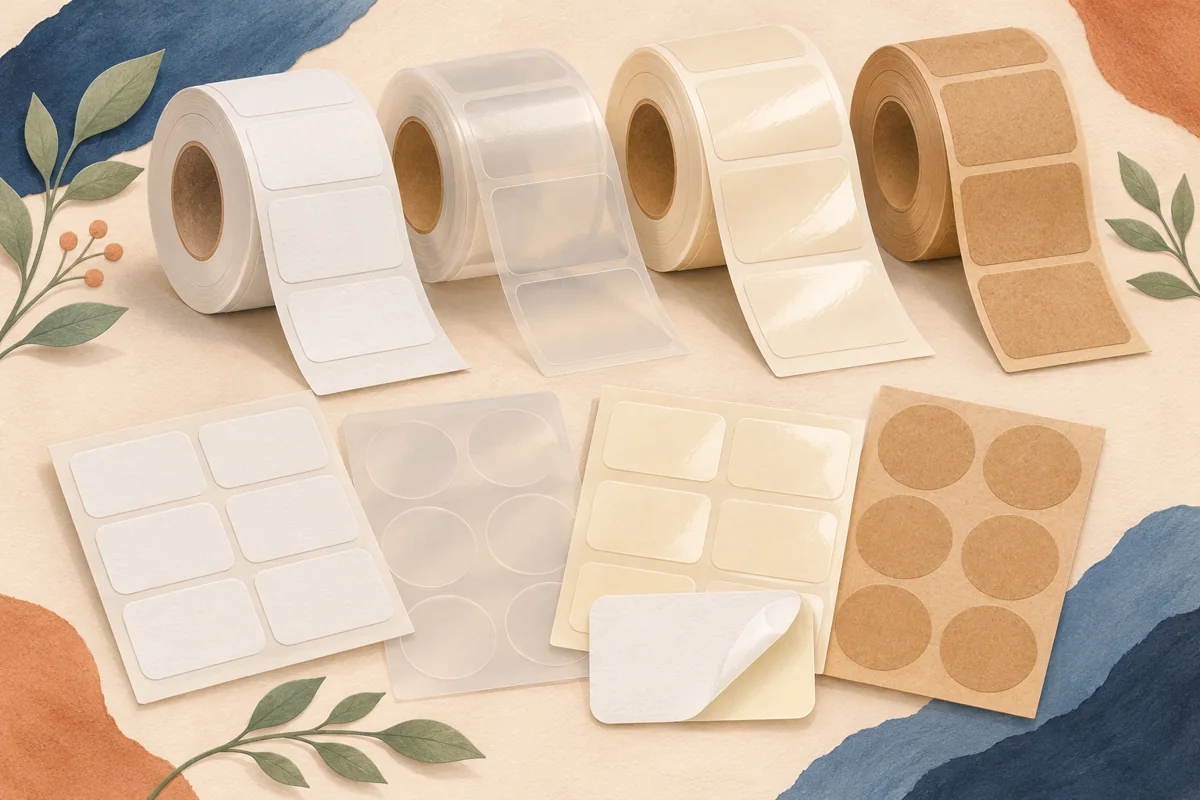
A physical color sample can make an approval discussion more concrete, but it still represents a particular construction and preparation. A swatch on white card does not automatically predict the same appearance on clear film with a different finish. Ask what the printer’s proposed drawdown or sample actually represents before using it as the color reference for a whole collection.
01
Ask what is represented and omitted
Request a plain description of how the sample was prepared and what it is intended to demonstrate. Avery Dennison’s application-testing services distinguish different performance evaluations; similarly, your color review should state its own limited question. A small sample may help compare intended hues without representing cutting, lettering or the complete production sequence. Avoid approving those unrelated properties by implication.
02
Keep substrate and surface in the record
Write the stock reference, printed side and any coating or laminate represented. Ask the printer whether the supplied sample matches the intended label construction or is a preliminary approximation. Compare alternatives under consistent viewing conditions and keep them identified. Without those records, a pleasing swatch can become an unreliable reference when the next order uses a different material.
03
Connect the chosen reference to the finished proof
Once a sample is accepted for its stated purpose, ask how the printer will use it during the production approval. Compare the actual label with the accepted reference while also checking wording and placement. Document any difference rather than quietly replacing the original reference. A retained sample is useful only when both parties understand the job and limits associated with it.
04
Make the sample reference transferable
Put the accepted sample identifier directly on the approval record and keep any remaining comparison swatches clearly labeled as alternatives. If another printer is asked to quote later, explain the reference’s purpose and construction rather than sending a loose piece of color with no history. Ask what that new supplier can reproduce and what new proof is needed. A transferable record should preserve the business’s intent without pretending every printer uses identical ink or finishing methods. This makes the sample a starting point for a precise discussion rather than an unexplained demand to match a scrap.
05
A practical example to adapt
For an illustrative room-spray range, request that three proposed blues arrive with clear stock and finish identifiers. Review them beside the actual bottle instead of judging unmarked scraps separately. Choose one as the agreed color direction, then ask for the finished label proof that includes the small scent line and full surface construction. If the chosen blue appears different after finishing, discuss whether the sample omitted that stage. Keep the preliminary comparison and the accepted finished sample in separate labeled sleeves. This gives the next order a meaningful reference while avoiding a claim that a single swatch proves every aspect of the finished package.
| Record | Decision to preserve |
|---|---|
| Purpose | Define the supported color decision |
| Construction | Identify stock and represented finish |
| Reference | Label the selected sample |
| Finished proof | Compare the complete label separately |
BEFORE YOUR NEXT STEP
Your practical checklist
- Purpose: Define the supported color decision
- Construction: Identify stock and represented finish
- Reference: Label the selected sample
- Finished proof: Compare the complete label separately
Questions & answers
Is a drawdown a complete label proof?+
Not necessarily. Ask the supplier what it represents and which production stages or design details it omits.
Can I approve a color from an unmarked swatch?+
Identify its construction and purpose first. An untraceable sample is a weak reference for repeat production.
Sources & further reading
Official references for the technical points in this guide. Check current specifications before production.