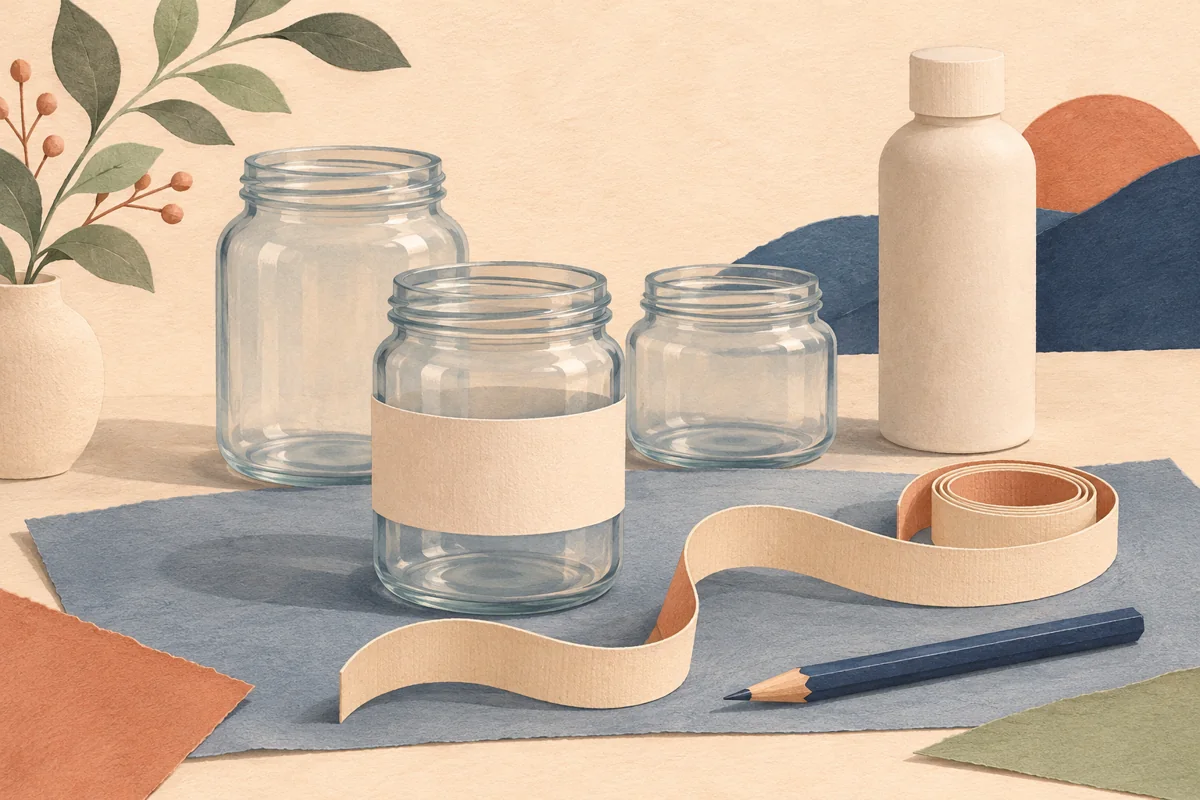
A spice jar needs to fit the cabinet as well as the design. Two jars described with a similar capacity may have different heights, shoulders and lids. Start with the physical destination, then check the space available for a readable front and a useful top identifier.
01
Measure the destination and the complete jar
Measure the shelf opening or drawer depth, including any raised tray or organizer. Then check the sample with its actual lid fitted. Leave the room your arrangement needs for picking up and replacing the jar. A bare glass measurement leaves out the closure that must fit in everyday use.
For an illustrative drawer, imagine a shallow front row and a deeper rear row. Compare a short jar and a tall jar in both positions. Photograph the top view with the drawer open. Decide whether every lid remains visible before committing to a matching set.
02
Separate capacity from the amount of spice
Container capacity describes volume, while the amount of a particular spice also depends on its form and how it occupies that volume. Whole peppercorns and ground cinnamon should not be assumed to produce the same net weight in the same jar. Use the correct product information for your package.
Ask the container supplier to distinguish the capacity terms in its specification. Berlin Packaging’s glass glossary distinguishes capacity measurements, which is useful when comparing listings. For the design decision, record the exact jar model and the physical labeling area rather than relying on a capacity nickname.
03
Compare two heights with one long name
Put Ground Cinnamon and Smoked Sweet Paprika on paper proofs. Keep the type treatment consistent and compare the longest wording first. On a short jar, a two-line product name may work more comfortably than reducing everything to a narrow band of tiny text.
Make the label system share a reading order across both jar heights. A short front could show the spice name prominently, while a taller version has room for a supporting line. Keep the written identity on each body even if you also use lid labels for drawer browsing.
| Comparison | Short jar | Tall jar |
|---|---|---|
| Usable front | Check shoulder and base curves | Check vertical panel height |
| Drawer view | Read the lid proof | Check overhead clearance |
| Longest name | Try a deliberate line break | Keep the same naming order |
04
Keep the approved physical reference
Use the actual closure and any shaker insert when completing the sample. Check the label against the parts buyers handle during opening. Select the adhesive and face material with your label supplier, who can consider the jar material and the handling conditions you describe.
Save one front photograph and one overhead photograph with the jar specification. Name the artwork by container model and panel size, then keep individual spice versions under that approved layout. A replacement jar should receive a new fit check even when its listed capacity seems familiar.
BEFORE YOUR NEXT STEP
Your practical checklist
- Measure the cabinet or drawer.
- Include the fitted lid in the height.
- Separate volume from spice weight.
- Proof the longest spice name.
Questions & answers
Is there one standard spice jar label size?+
There is no useful universal size for every jar. Measure the smooth panel on the container you will use.
Should I use a front label or a lid label?+
Choose the first viewing surface, then repeat the written identity where necessary. A drawer often benefits from a lid identifier.
Sources & further reading
Official references for the technical points in this guide. Check current specifications before production.